Showing posts with label PLM Implementation. Show all posts

Monday, January 16, 2012

Holiday Spending, Returns and Need for a Closed Loop PLM System

I was reading about the 2011 U.S. Christmas Holiday Retail Data this weekend and noted some interesting points:
  1. According to the National Retail Federation, December retail industry sales (which exclude automobiles, gas stations, and restaurants) increased 4.1 percent to $471.5 billion – slightly surpassing NRF’s holiday sales forecast of 3.8 percent growth. [source]
  2. Gifts are the most common purchase that consumers make during the major holidays (nearly 50%). Top gifts categories were: Clothes, Gift cards, Electronics, Jewelry, Home and garden, Personal care, cosmetics and pampering, Toys, sporting goods and hobbies. 
  3. Shoppers are expected to return 9.9% of their Christmas purchases, which would be the highest return rate since the recession.  [source]
  4. $46 billion of merchandise is predicted to be returned, which would be a 4% increase when compared to holiday gift returns in 2010. About 33% of shoppers said they return gifts in the NRF 2011 Holiday Returns Survey. [source]
  5. Reasons for returns vary: Buyer’s remorse, better deals elsewhere, unwanted gifts, too many of certain kind, shopping error etc. [various sources]

One of the major reasons for return also is because of manufacturing defects. Usually all merchandise with manufacturing defects that are returned by customers are claimed back to the producer by retail vendors, even if this occurs after the “selling season”. Although I couldn’t get any specific data on the amount of returns due to faulty products but I assume it will be a significant amount in dollar terms. 

Managing product returns due to manufacturing defects, obsolete products and shipping errors is difficult to say the least. Manufacturers must manage the reverse flow efficiently to ensure maximum recovery, and reduced wastage. While larger manufactures due to deeper pockets might be able to withstand the financial effects of high returns, smaller manufacturers tend to lose a lot more. 

Hence it is imperative that they: 
  1. Integrate their Quality Lifecycle Management (QLM) and Reliability Management solutions with their PLM solution. This will not only trim down the cost of poor quality but also will allow them to utilize lessons learned to augment product designs (thereby closing the loop in the product lifecycle).
  2. Integrate Warranty Management into PLM so that manufactures can build an early-warning closed-loop system which will enable continuous product and service improvement.
  3. Develop strategies for End-Of-Life Management so that returned products can be refurbished, repaired or disposed efficiently and in a cost-effective manner. For high-value, high-velocity products it makes sense to integrate the Returns Management platform with PLM for better asset recovery, warranty, returns, repair, and refurbishing, packaging and repackaging services.

My 2 cents – Would like to hear your thoughts on this.

Friday, October 14, 2011

What Google+ failure can teach about PLM implementation and User Adoption?

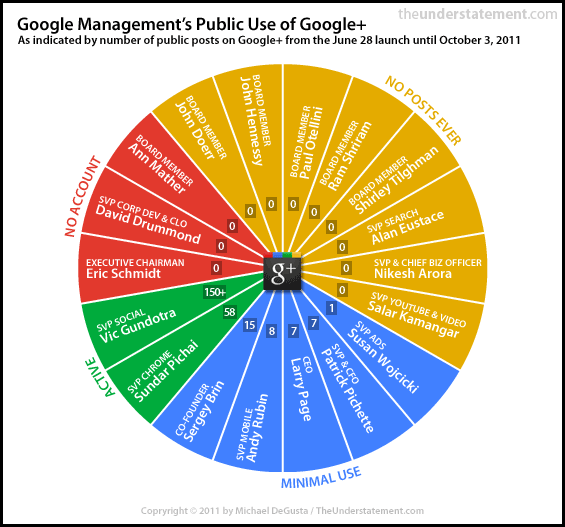
A few days back, Google engineer Steve Yegge wrote a classic tirade about Google's inept handling of the Google+ platform. (You can read it all here). Google+ was supposed to be a Facebook killer, but slowly it is turning to be another Google Wave/Buzz. One of the most interesting things pointed out in the blogpost was “The Golden Rule of platforms is that you Eat Your Own Dogfood. The fact that Google doesn’t even eat its own dog food is very evident in this post from a few days back.

As I read this post, I realized how many times we have implemented PLM at various sites and, what the end result has been - all along we have known for a fact that the one of the key measure of a winning and thriving PLM implementation was effective user adoption. And this not mere consultant conjecture, this has been validated by research too - According to a study done by the Sand Hill Group and Neochange, the most critical factor (70% listed as number 1) for software success and return-on-investment is effective user adoption. Software functionality came in at 1% surprisingly, with organization change at 16% and process alignment at 13%. No wonder Google+ has been a nonstarter (Paul Tassi has even written “A Eulogy for Google Plus”)

So what can we learn about Google+ hopeless case and how it relates to a successful PLM implementation from a user adoption standpoint? Several I would say:

1.     Not Enough Power Users (or Management Support or Practice what you preach): Google's Schmidt finally took to Google+ only a couple of days back. Most members of the company's management team aren't still using Google+. Likewise if your PLM implementation has to be successful the concerned top level management has to use it. No point if the VP or Director of Engg/Rnd still uses emails to approve designs or wants printed copies or whatever completely bypassing the system.

2.     Have Real Value for the End User: If the current PLM system is just a replacement for the old one with lots of cute UI’s and bells and whistle – quite likely the reaction is going to be the same as was with the old one once the initial hype cycle dies down.

3.     Launch when ready: Most people would advocate implementing PLM in phases. Good point. But just because you have to close out one phase to start another doesn’t mean you need to roll out a half baked product/service to the user community.

4.     Vendor Size Doesn’t Matter: Even with an 800 pound gorilla’s backing, Buzz, Wave and now + failed. Likewise even if the vendor is large or their PLM system caters to the biggest of the big Fortune 500 companies, it’s not necessary that it will cater to all your user needs. Give your users what they want to be successful in getting their job done. Don’t focus almost exclusively on tiny little features that few people will ever use.

5.     Customize if needed: Oh yeah, that’s a bad word – We don’t want to customize and keep on paying for the maintenance! Right – But what is the point in using terminology or vendor mandated business processes which the user community doesn’t understand? I still don’t get circles, stream, hangouts or whatever.

6.     Motivate People to Use it: People simply didn’t move in droves from Facebook to Google+ as was expected. There was no motivation to do so. FB was sufficient to satisfy the needs of most of the users. Just because something is mandated by the organization doesn’t mean that the users will use it or be happy to use it (sometimes you don’t have a choice – like using LotusNotes or HP’s Quality Center for example!). Motivate the end users to use the new PLM system – Have a plan much before go-live!

7.     Integration: Well Google+ has probably integration with lots of websites and stuff, but Facebook is better! Host of games and apps and I can even sign into/comment on a bunch of websites using my Facebook id. Similarly if the PLM system doesn’t have integration to systems like corporate LDAP, or the SMTP server or inaccessible externally users would have tough time getting on-boarded.

Probably I can go on and on but I hope readers get the point! Don’t take user adoption unconscientiously – it’s the key to a triumphant implementation. (I wouldn’t underestimate Google though – Maybe this time they will get it right – eventually)

Saturday, September 24, 2011

The under-appreciated role of PLM in implementing Document Creation Retention and Destruction (DCRD) policies


Have you heard about the famous (or infamous?) “Pitt’s Postulate”: “Whenever you think you’ve destroyed the last copy of any document, there’s always one more that exists, and it will surface at exactly the most inopportune time. The only exception, of course, is if you really need the document, at which point you’ll discover that you actually did destroy the very last copy.” – Quite true, isn’t it? Over the last few years businesses have come to appreciate that they need to better manage their documents and records to tackle a number of key issues including legislation's like SOX, risk of lawsuits, protection of intellectual property and identity theft. Most corporations have formalized Document Creation, Retention and Disposal (DCRD) policies, primarily outlining the length of time for which the organization will keep certain documents and records, either in hard copy or electronic form. These policies serve as guiding principles for employees, indicating which documents to discard and which to save while ensuring compliance with laws and hindering inadvertent or ingenuous destruction of records.

Numerous off-the-shelf solutions are available for such purposes (including SharePoint which impelled me to write this article) but if a company has already implemented a commercial PLM system then they in all probability do not need to go for another system to take care of DCRD policies. Record/Document classification, integrity, storage, access control, data retention, backup, data purging, comprehensive version and revision control, viewable file generation, auditing, search etc. are all effectively present in a enterprise PLM system.
 
What are the challenges before trying to get PLM in managing corporate records?

→ Assessment of different document type and their value needs to be determined first – Certain type of documents might not be suitable for storage in PLM like employee evaluations or expense reports etc when other systems are present to manage them.
→ Emails in particular – Time and again emails have been the center of attention in much litigation and unfortunately the retention/control/purge of emails is out of PLM’s scope.
→ Backups – Electronic data backup produce historical copies of documents/records which even though purged from the current system will be preserved in archives and are discoverable.
 
My conclusion: PLM is a viable solution in conjunction with other systems to aid implementation of DCRD policies. If a PLM solution is present then a new Records Management solution doesn’t need to be implemented.

Tuesday, September 6, 2011

Using Rule-Based or Supervised Document Classification for Legacy Data Migration in a PLM Implementation

I was reading about Latent Semantic Analysis (LSA, also Latent semantic indexing ) recently and the controversies over whether Google used this technique to rank their search results, though the jury seems to be that they use something much more sophisticated statistical methods of text analysis. Latent semantic analysis (LSA) is a technique in natural language processing, of analyzing relationships between a set of documents and the terms they contain by producing a set of concepts related to the documents and terms. LSA assumes that words that are close in meaning will occur close together in text.

Latent semantic indexing is closely related to LSA and is used in a assortment of information retrieval and text processing applications, although its primary use is for automated document categorization. Document classification/categorization are used to assign an electronic document to one or more categories, based on its contents. Document classification tasks can be divided into two sorts: supervised document classification where some external mechanism (such as human feedback) provides information on the correct classification for documents, and unsupervised document classification (also known as document clustering), where the classification must be done entirely without reference to external information. There is also a semi-supervised document classification, where parts of the documents are labeled by the external mechanism (Rule Based). There are Open Source tools [like Mallet] for statistical natural language processing, document classification, clustering, topic modeling, information extraction, etc.

The reason I bring up this topic in my experience in legacy data import during PLM implementations. Legacy data migration is tough to say the least. Stephen Porter gives a good overview here: The PLM State: What’s thebig deal about data migration?. Some of my real life experiences include:  

1.       Manual scanning of historical documents, manual classification of those documents into folders and uploading it to the PLM environment using vendor tools in a FDA regulated organization’s implementation.

2.       Legacy data extraction from a commercial document management system, mapping data with vendor PLM system, cleaning the legacy data, and finally data import.

3.       Legacy system consolidation - Merging numerous home grown legacy systems into one commercial PLM system.

None of the processes used were scalable or easy to start with. Also the amount of time taken cannot be guaranteed. In such scenarios wouldn’t using Rule-Based or Supervised Document Classification make sense? Arguably CAD data would be difficult to handle and historical revisions or intermediate iterations of files between releases might be lost but probably for non-CAD data using such techniques would make up for huge investments in time and labor for legacy data migrations.